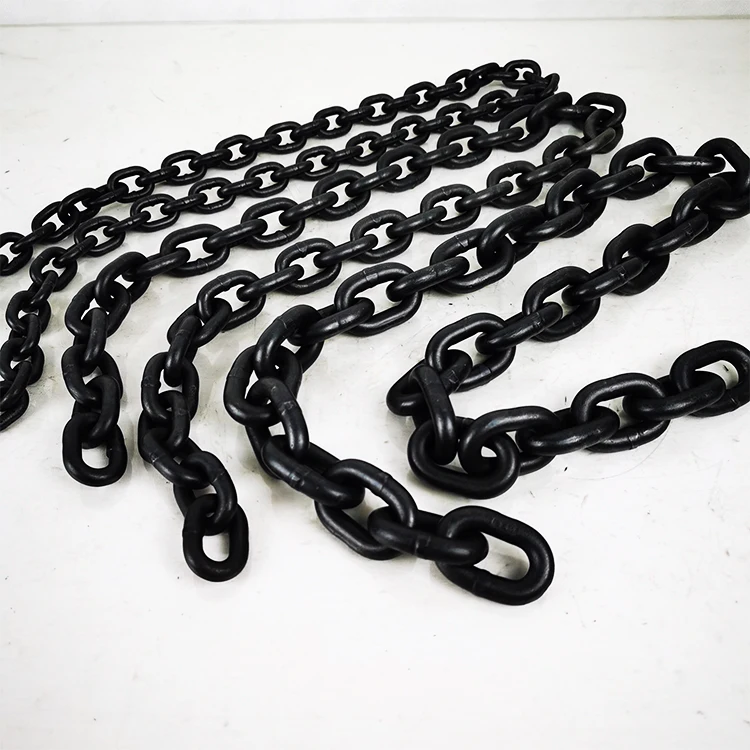
Surface treatments for chains are applied to enhance their performance, durability, and resistance to various environmental factors. Different types of surface treatments are used depending on the specific requirements of the application. Here are some common surface treatments for chains:
1.Galvanizing:
Hot-Dip Galvanizing: Chains are immersed in a bath of molten zinc, providing a protective coating against corrosion. This is commonly used for outdoor applications.
2.Nickel Plating:
Electroless Nickel Plating: Chains are coated with a layer of nickel, providing corrosion resistance and improved wear resistance.
3.Chrome Plating:
Hard Chrome Plating: This involves electroplating a thin layer of chromium onto the chain surface, improving hardness, wear resistance, and corrosion resistance.
4.Dacromet Coating:
Dacromet is a type of corrosion-resistant coating that provides a thin film with excellent adhesion to the chain surface. It is often used in automotive and industrial applications.
5.Black Oxide Coating:
Also known as blackening, this process involves converting the surface of the chain into a layer of black oxide, providing some corrosion resistance and an attractive appearance.
6.Powder Coating:
Chains can be coated with a layer of powder that is electrostatically applied and then cured under heat. Powder coating provides a durable and corrosion-resistant finish.
7.Case Hardening:
In case hardening, the outer layer of the chain is hardened to improve wear resistance while maintaining a tough core. This is often used for heavy-duty applications.
8.Nitriding:
Nitriding involves diffusing nitrogen into the surface of the chain, creating a hard and wear-resistant layer. It is particularly effective for high-stress applications.
9.Phosphating:
Phosphating is a chemical conversion coating that can be applied to chains to improve corrosion resistance and provide a base for additional coatings.
10.Teflon Coating:
Chains can be coated with Teflon (PTFE) for reduced friction and enhanced resistance to wear and corrosion.
It's important to choose the appropriate surface treatment based on the specific environmental conditions, load requirements, and other factors relevant to the intended application of the chain. Each surface treatment has its advantages and limitations, and the choice depends on the desired properties for the particular use case.